


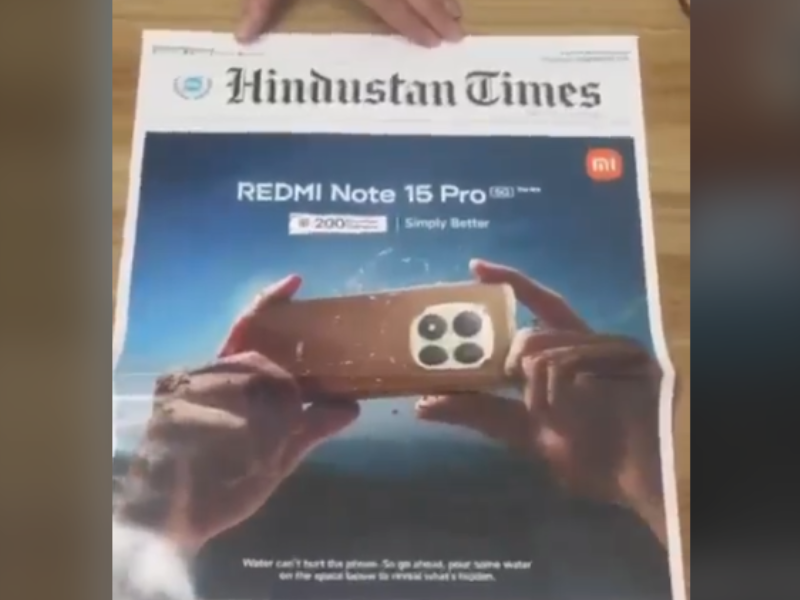
Redmi’s latest print advertisement for the Redmi Note 15 Pro has sparked widespread attention on LinkedIn, highlighting how traditional media is increasingly discovered and amplified through digital platforms. The ad, reportedly published in Hindustan Times, features an interactive execution where pouring water over a section of the newspaper fades the ink to reveal the phone’s price-transforming a static print format into a tactile, share-worthy experience.
Several LinkedIn users posted videos demonstrating the water-reveal mechanic, turning the physical interaction into digital content. What drew further attention was the pattern of circulation: multiple posts surfaced on the same day, many sharing identical visuals and similar copy. While it remains unclear whether this traction was organic, coordinated, or coincidental, the moment reflects how modern launches often blur the lines between paid promotion, creator amplification, and genuine virality-especially when disclosures are not immediately visible in social formats.
Creatively, the execution aligns closely with the product’s positioning. The Redmi Note 15 Pro series is being marketed around durability, alongside camera and battery performance. The device reportedly carries multiple water and dust resistance certifications, including IP66, IP68, IP69, and IP69K, reinforcing protection against splashes, submersion, and high-pressure water exposure.
The campaign also leans into performance-led storytelling, with the series expected to feature a 200MP primary camera, a large silicon-carbon battery in the ~6,500mAh range, and an AMOLED display-signaling Redmi’s upper mid-premium ambitions.
The LinkedIn caption accompanying the videos frames the water reveal as metaphor-led storytelling, suggesting that if water can uncover the price, it shouldn’t be a concern for the phone itself. As the ad states, “We didn’t choose between camera and durability. Neither should you.”
While the physical print placement could not be independently verified at the time of publishing, the conversation itself underscores a key takeaway: when print behaves like digital-interactive, shareable, and conversation-led-it still has the power to travel far beyond the page.