



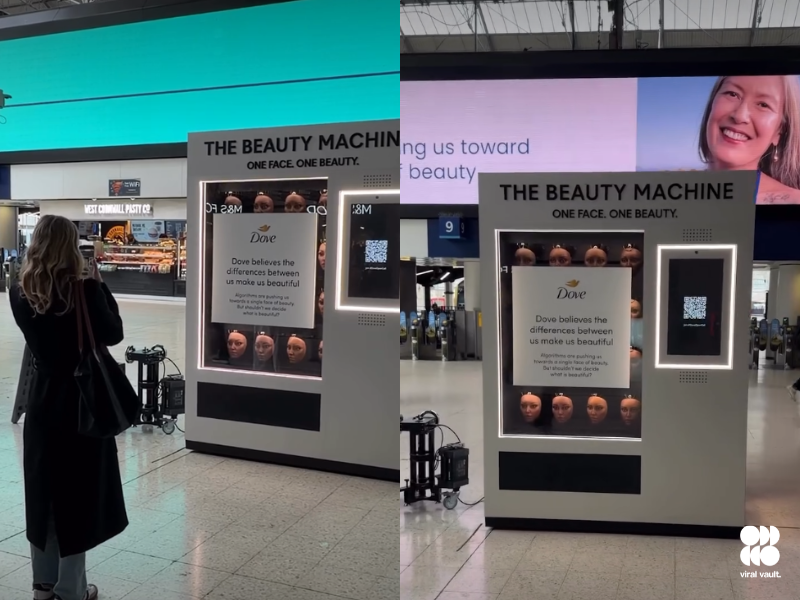
In March 2026, Dove brought a striking public activation to Waterloo Station, turning everyday commuting into a moment of reflection on beauty standards shaped by social media. Titled The Beauty Machine, the installation used a vending machine concept to challenge how algorithms influence perceptions of appearance.
Video Link: https://www.instagram.com/reel/DWlU_6fNtxr/?utm_source=ig_web_copy_link&igsh=NTc4MTIwNjQ2YQ==
At first glance, the setup resembled a typical vending machine. But instead of snacks or drinks, it displayed rows of identical-looking faces-each representing a filtered, “perfect” version of beauty commonly seen online. While it appeared to offer choice, the machine repeatedly cycled through the same features, mimicking how social media feeds often present limited, homogenized aesthetics.
This visual metaphor highlighted a growing concern: despite the illusion of diversity, algorithms tend to reward and amplify a narrow definition of beauty. Over time, this creates a “sea of sameness,” where individuality is overshadowed by trends driven by filters, edits, and engagement metrics.
The activation is rooted in insights from the Dove State of Beauty report, which revealed that nearly half of women and girls in the UK feel pressured to alter their appearance-even when they are aware that the images they see are digitally manipulated. By bringing this issue to life in a real-world setting, Dove aimed to spark awareness and conversation around these unrealistic standards.
To extend the impact, Dove introduced #DoveOpenCall, inviting people to share unfiltered selfies via a QR code or social media. These real, diverse faces were then displayed on digital billboards and Dove’s platforms-serving as a powerful counterpoint to the machine’s “perfected” faces.
With The Beauty Machine, Dove reinforces its long-standing commitment to redefining beauty-encouraging authenticity over algorithm-driven perfection and reminding audiences that real beauty cannot be standardized.